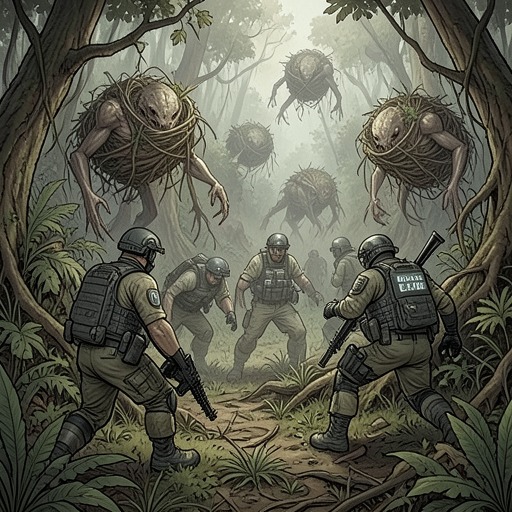
Gunfight at the St. Augustine Culvert Nest
Secret InvasionThe gunfight at the St. Augustine culvert nest turns a routine coastal search into a close-quarters battle against multiple Sliggers. Finding a clutch of eggs beneath two highways confirms that the creatures can occupy concealed drainage infrastructure, while the sudden attack shows the danger of approaching a nest without knowing how many defenders are nearby. The team survives and calls for gasoline and help removing the dead creatures, but the episode leaves the nest’s destruction to the cleanup that must follow.
A hidden nest in the search area
The encounter takes place during a search of the St. Augustine area, where the team has been looking for eggs or other evidence of nesting. The searchers move through knee-high sea oats in the heat, but find no signs on the beach. A clear search would have allowed them to declare the area safe; instead, Ron Tully notices reeds partly covering a culvert and stops the line to investigate.
The structure is a roughly 300-foot storm drain passing beneath two two-lane highways. Its rectangular entrance is about five feet high, large enough to admit both people and the creatures. Josh Moody proposes checking it, and David Mittenfeld agrees. The group leaves the search line, crosses a slope to reach the concrete opening, and enters with flashlights. Josh takes the lead, David stays beside him, Ron and Andy Carlyle follow close behind, and Denise Baddington brings up the rear.
Signs of danger underground
Inside, the drain is musty and muggy, with stagnant water, mold, and sour air. Josh’s flashlight first lands on an alligator carcass whose body is missing from the chest down. Twenty feet farther on, the group finds another alligator, also partly eaten. The worsening smell of rotten eggs is familiar enough to make the searchers tense: these are not simply signs of animal remains, but warnings that they may be close to Sliggers.
They find the nest in a wet corner of the culvert. Large greenish eggs lie together in a pile, confirming that the drain is not merely a route through which a creature has passed but a breeding site. The discovery raises the immediate danger: a nest is likely to have protective adults nearby. Ron directs his flashlight behind the group, but the first attack comes from the other direction, as a beast charges into Josh’s beam.
The firefight
Josh fires his Remington repeatedly until the first monster drops. A second appears, its appendages flailing, and the possibility of more behind it is clear. David joins the shooting while Josh runs out of bullets within seconds. He steps aside so the others can get clear shots. The second creature falls, followed by a third and a fourth; in the sudden quiet, the group gathers near the nest and begins considering how to destroy it.
That apparent lull is broken when another Sligger leaps from the darkness. A flashlight catches it at the last moment, before it can reach Josh. Ron swings his gun around and fires a hollow-point .45 round, striking the creature between the eyes. It collapses. The exchange makes the culvert’s central hazard unmistakable: even after several attackers have been shot, the dark drain can still conceal another one close enough to charge.
Cleanup and wider significance
Other officers, drawn to the entrance by the gunfire, call in to check on the team. David reports that they have found a nest and dead Sliggers, then asks for gasoline and help dragging the bodies out. The request marks the transition from combat to containment. The team has stopped the immediate attack, but the scene does not establish that the eggs have been destroyed; removal and disposal remain necessary steps rather than an accomplished result.
That distinction matters in the broader response. Earlier warnings stressed that nests should be found and destroyed, and that killing creatures carelessly could spread mutated tissue into the water. Denise later emphasized recovering and burning carcasses so scavengers could not carry mutated DNA farther through the food chain. The culvert encounter gives those procedures a concrete setting: eggs are concentrated in a damp, hidden site, while several dead predators must be removed from an enclosed waterway environment.
The nest also belongs to a crisis understood as a network of sites rather than a single outbreak location. Denise had warned that widely separated attacks meant multiple nests and that the creatures could be anywhere along the coast. Investigators suspected that an unknown substance from the Wrecker Island Nazi U-boat had caused genetic mutation; Denise’s theory was that generations of Sliggers acquired traits from the marine animals they ate. Later, authorities traced movement along coastal currents in the Gulf of Mexico and reported a nest near Baton Rouge, followed by a search north toward St. Francisville. In that larger campaign, the St. Augustine firefight is a vivid example of the work required at each hidden site: discover the nest, withstand its defenders, and prevent the remains from becoming another route of contamination.